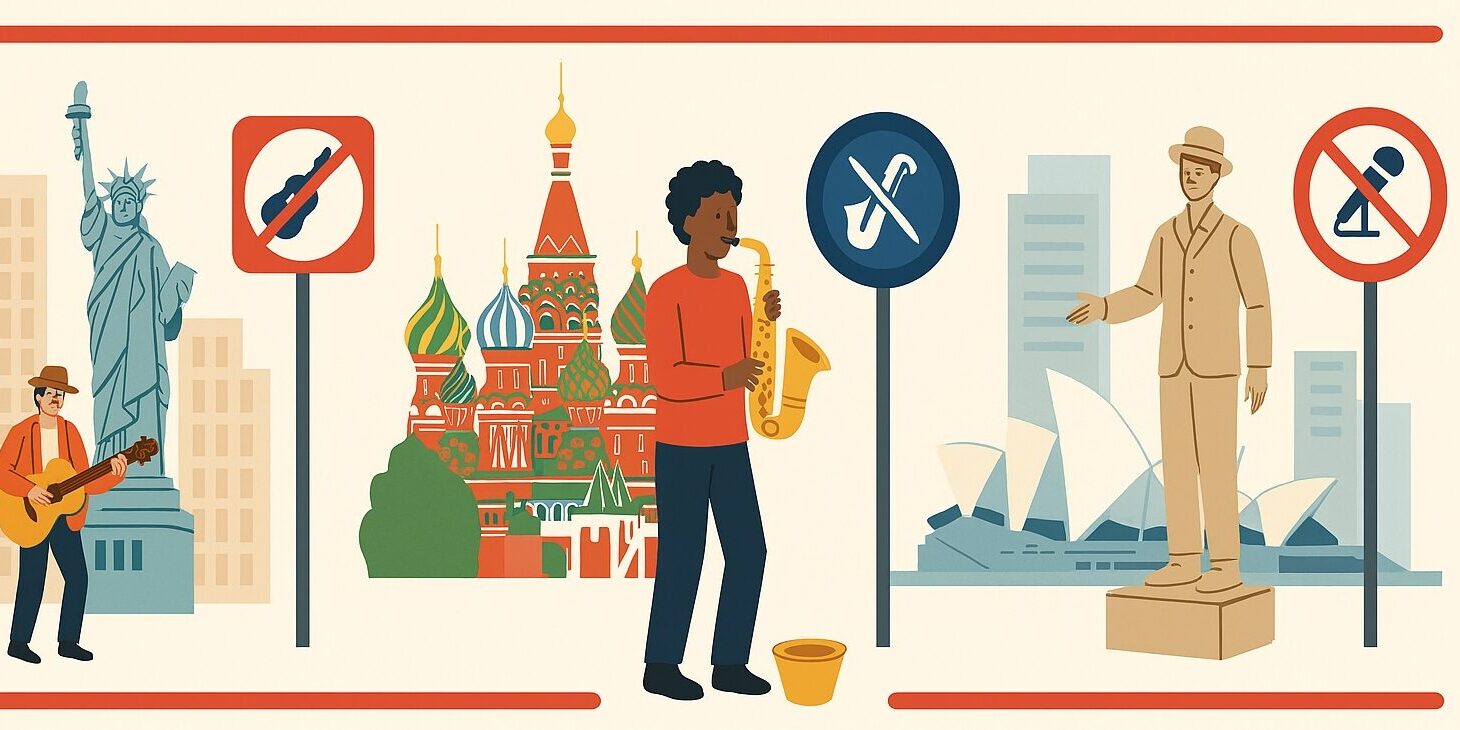
In August 2025, Birmingham City Council introduced a sweeping Public Spaces Protection Order (PSPO) that effectively bans all busking in key areas of the city centre until 2028. The stated aim: to reduce noise pollution and improve public wellbeing. The order prohibits the use of amplification equipment, musical instruments, or any items used as instruments in designated zones such as Victoria Square, New Street, and Temple Street. The order bans all forms of amplified or instrumental street performance in the city centre, with violators facing fines of up to £1,000. While businesses cited mental health concerns and customer disruption, critics argue the ban is a disproportionate response to a manageable issue.
The backlash was immediate. The Musicians’ Union (MU) condemned the move as “draconian,” accusing the council of turning Birmingham into “the city that banned culture.” The MU, alongside groups like Keep Streets Live, had proposed alternative solutions — such as designated performance times or zones — but these were rejected. MU Midlands Regional Officer Stephen Brown warned that the city was becoming a “cultural wasteland,” especially after the council also cut all arts funding earlier in the year (MU, 2025). Birmingham’s PSPO bypassed the licensing debate entirely by imposing a blanket ban. This approach has been criticised for ignoring workable alternatives deployed elsewhere.
This blog explores how other cities — in the UK and globally — regulate busking, organised around key themes: licensing, location and time restrictions, amplification and noise, enforcement and conflict, and cultural recognition. The text is based on the ongoing research within the Live Music Mapping Project, Birmingham’s team.
Licensing: From Permits to Voluntary Codes
Licensing is one of the most divisive aspects of busking regulation. Some cities, like Chengdu in China, have developed highly structured systems. Since 2018, Chengdu requires performers to apply through a government-backed app, submit ID and performance samples, pass a background check, and complete training. Once approved, performers receive a certificate and can claim pitches via a live map. Similar, in Melbourne, busking is governed by the City of Melbourne Activities Local Law 2024, requiring all public performances to be licensed (with four types of permits, dependent on specific criteria and zones).
In contrast, cities like Wellington and Auckland in New Zealand also require licences, but these are free and relatively easy to obtain. The process is designed to encourage creativity while maintaining public order. Valparaíso in Chile offers a hybrid model: licensing is optional unless performers exceed certain thresholds, such as using high-powered amplification or performing near sensitive institutions.
Meanwhile, many UK cities take a softer approach. Cardiff and Swansea operate under voluntary guidelines, encouraging good practice without formal permits. Manchester, Newcastle, and Edinburgh do not require licences but enforce codes of conduct. Liverpool is a mixed case: while the city itself does not mandate licences, performers in the privately managed Liverpool ONE retail area must apply for permission.
Location and Time: Managing Space and Flow
Regulating where and when busking can occur is a common strategy to prevent overcrowding and disruption. Most cities impose time limits on performances. In Manchester and Wellington, performers are allowed to play for up to 90 minutes in one location. Valparaíso enforces a one-hour limit and requires a two-hour gap before returning to the same spot. Newcastle follows similar rules, with shorter time slots for louder acts.
Location restrictions are also widespread. Valparaíso prohibits performances within 100 metres of hospitals, schools, and other sensitive institutions. In Manchester and Edinburgh, performers must maintain a 50-metre distance from each other and avoid obstructing public pathways. Santiago, Chile’s capital, previously designated 14 specific spots for busking, with defined time slots and amplification rules. Melbourne enforces location-specific rules, with premium areas like Bourke Street Mall reserved for Premium Permit holders with 30-minutes allocation (in contrast to 2h limit in other locations).
These measures aim to balance cultural activity with urban functionality. Birmingham’s decision to ban busking outright in certain zones, rather than managing it through time and space restrictions, stands out as unusually severe.
Amplification: The Noisy Debate
Amplification is often the flashpoint for complaints and regulation. Cities take varied approaches to managing sound levels. Valparaíso sets clear limits: solo performers may use up to 30 watts, while groups are allowed 90 watts. Higher levels require a licence. Wellington mandates that sound should not exceed background noise beyond 30 metres, while Newcastle allows amplification only with prior permission and at very low levels.
Some cities opt for outright bans. Manchester prohibits amplification entirely, along with loud instruments like drums and trumpets. Santiago’s earlier ordinance banned amplification before 7pm and allowed moderate use only during specific hours. Auckland, on the other hand, permits amplified sound between 7am and 9pm, with extended hours in designated areas. In Melbourne, amplified sound is prohibited in sensitive zones and residential frontages unless authorised.
Birmingham’s PSPO takes the most extreme stance, banning all amplification in designated areas regardless of volume or context.
Enforcement: Conflict vs Collaboration
Enforcement strategies reveal much about a city’s cultural priorities. Valparaíso offers a model of collaborative governance. Its ordinance was co-designed with artists, residents, and business owners, aiming to foster coexistence rather than punishment. Cardiff’s Music Board similarly proposed a Buskers’ Code and taskforce to avoid heavy-handed enforcement.
In contrast, cities like Beijing and Santiago have more adversarial relationships with street performers. In Beijing, urban management officers routinely disperse buskers to prevent crowding. Santiago’s performers report frequent conflict with police and municipal inspectors, especially when treated like informal street vendors. Edinburgh uses a “yellow card” system to warn rule-breakers before escalating enforcement. Melbourne adopts an educational enforcement approach, with fines for non-compliance ranging from AUD $500 to $3,000.
Birmingham’s PSPO empowers officers to issue fines of up to £1,000, with no provision for dialogue or appeal. The Musicians’ Union argues this criminalises culture and ignores more constructive approaches seen elsewhere.
Cultural Recognition: Busking as Urban Identity
Busking is more than entertainment — it’s part of a city’s cultural fabric. Valparaíso, a UNESCO City of Music, explicitly protects street performance through its ordinance. Santiago’s chinchineros, traditional street performers, are recognised as Intangible Cultural Heritage, though enforcement remains inconsistent. New Zealand cities celebrate busking through festivals and tourism campaigns. Cardiff’s music strategy views busking as a public asset, recommending high-quality pitches and encouraging performers to move around the city. Even Melbourne, with stricter regulation, views busking as a legitimate form of creative expression and “supports” it through structured permits and designated zones, maintaining that the system fosters a vibrant street arts culture while safeguarding public space usage.
Birmingham’s ban, coupled with recent cuts to arts funding, raises questions about its commitment to cultural life. The Musicians’ Union warns that the city risks becoming a cultural wasteland, especially when other cities are embracing street performance as part of their identity.
What Birmingham Can Learn? Regulate, Don’t Eradicate
Cities like Chengdu, Wellington, Cardiff, and Valparaíso show that it’s possible to balance vibrancy with regulation. Free or low-barrier licensing, flexible codes of conduct, designated pitches, and community consultation all contribute to a healthier street performance culture. Birmingham’s PSPO, by contrast, is seen by many as a “sledgehammer to crack a nut,” punishing all performers for the actions of a few.
With council elections looming, the decision may have lasting political and cultural consequences. The Musicians’ Union and other critics argue that Birmingham should reconsider its approach and engage with performers to find a more balanced solution.
Busking is a living expression of urban culture. While regulation is necessary, blanket bans risk silencing the soul of a city. Birmingham’s PSPO may be enforceable, but whether it’s sustainable — culturally or politically — remains to be seen. As cities around the world show, the key lies not in prohibition, but in partnership — between performers, councils, businesses, and the public. The beat goes on — but only if we let it.