

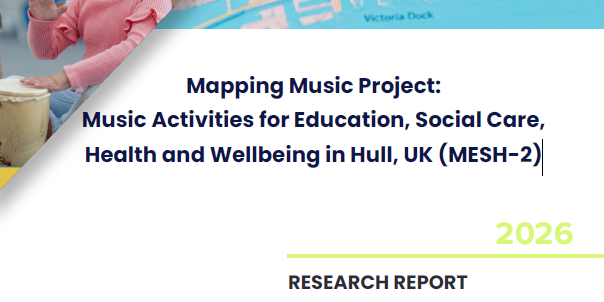
We are delighted to share a new research report from colleagues at the University of Hull, Mapping Music Project: Music Activities for Education, Social Care, Health and Wellbeing in Hull, UK (MESH-2). The project was led by Dr Elaine King with Dr Graziana Presicce, Dr Helen Prior and Dr Caroline White, working in collaboration with the Live Music Mapping Project (LMMP) team.
The project demonstrates how the mapping approaches developed through LMMP can be adapted to investigate different dimensions of local music ecosystems. While LMMP has primarily mapped live music venues and the relationships between venues, musicians, local economies and regulation, the Hull study concentrates on community music activities supporting education, social care, health and wellbeing.
Explore the Hull Live Music Map
The research also provides a detailed picture of Hull’s community music provision. 129 people participated in the survey, comprising 100 music activity organisers and 29 attendees. Most of the reported activity sits within the community sector, with a particular emphasis on education and health and wellbeing. The research identifies six recurring purposes for community music activity: enabling social connection, improving health and wellbeing, providing safe spaces for relaxation and enjoyment, education, creating opportunities to make music, and supporting the local creative economy.
The findings also identify challenges facing Hull’s community music ecosystem. These include limited visibility of some provision, reliance on particular funding sources, gaps in provision in East Hull and social care, and comparatively limited provision identified for groups including babies and toddlers, people experiencing homelessness or substance misuse, and people receiving palliative care.
The report makes six recommendations for strengthening music activity in Hull, including creating a Music Activity Network, diversifying funding and providing grant support, improving the visibility of music activities, supporting volunteers, expanding provision and encouraging more people to make and sustain music within their communities.
Importantly for LMMP, the Hull collaboration shows how a common mapping infrastructure can be adapted to answer new questions about a city’s music ecosystem. The report describes the work as testing new approaches to facilitate expansion of LMMP’s remit, including experimental categorisations and analytical choices relating to community-sector activity.
The collaboration also demonstrates the value of connecting mapping with locally focused research: rather than simply showing where music happens, mapping can provide an evidence base for identifying gaps in provision, understanding access and visibility, and informing future support for local music ecosystems.
Read the full report: Mapping Music Project: Music Activities for Education, Social Care, Health and Wellbeing in Hull, UK (MESH-2)
Explore the map: Hull Live Music Map

